Thursday, January 07, 2010

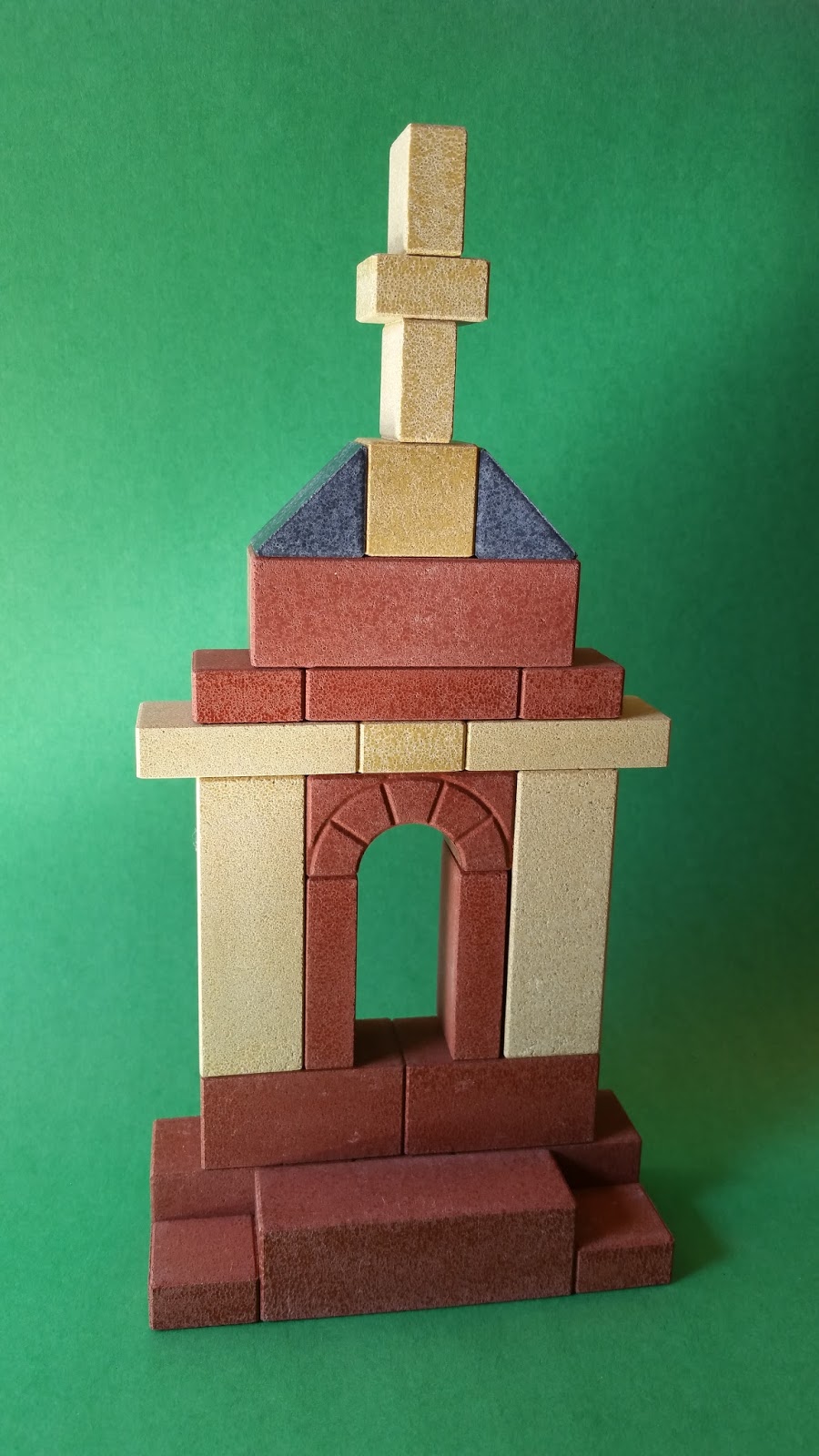
Tomola

There were Ankerstein copiers all over, some well known and others not so well known.

Tomola may fall into the least known category, or if not, the least known are ones I still haven't heard of.

The box says they are made by "The Beton and Ceramic Factory Limited Co." of the Ujpest district of Budapest, Hungary.

I am inclined to believe that "Beton" is the same as the German word, which means "concrete," and that the concrete portion of the business contributed more to the technical development than the ceramic side.

The sand may be a finer grit than we are used to in concrete, but these feel much more like concrete than do Ankerstein, much less Lott's.

Even though it's out of register, it is worth clicking on the example plan sheet to see someone else's take.

These blocks are 20mm, the same is the earliest Ankerstein, and Richter's later Kleinkaliber, rather than the 25mm of later Ankerstein or 25.4mm of Lott's. I like the size, but it is less suitable for larger structures. Same goes for me, so there.

On another note, I have been tickled with the news coming out of CES about all the 3-D stuff coming along. Now I want the new Fujifilm 3D digital camera even more.

For now, I will keep shifting my Olympus sideways for stereo pairs (below).

Much fun & good block play.

Monday, December 21, 2009

K'nex Bridge in 3D

This bridge is from the K'nex Building Bridges set, which progressively explores a dozen bridge designs. Some of the later ones are more impressive, but I was more interested in making a stereograph than a bridge.

If you look at these images with a stereo viewer or by merging the two images with a free-viewing technique, it will be in 3D, ala the View-Master many of us enjoyed as kids, and some of us still enjoy.

No big whoopee, but this is my absolutely first stereo pair, so I am kind of pleased.

I used my regular camera, moving it to the side between exposures to create the divergent points of view.

The Manfrotto Modopocket may be my favorite camera accessory. For the stereograph (3D image pair), I put a metal ruler with a non-slip cork back on the table with the ends weighted, put the Modopocket against the ruler, and displaced it to the side along the ruler to create spaced parallel images for manipulating into a stereo pair.

For more on 3D photography, you might start with DrT's website.

Much fun.

And another way to enhance what was already good block play.

Addendum [12/24/09] - In my confusion, I had originally referred to the technique for viewing my image pair as using the "cross-eyed technique," which Dr T was kind enough to gently point out was wrong, since that requires a reversed stereo pair. I have corrected both the terminology and the link above.

Thursday, December 10, 2009

Frontier Logs

Okay, I admit to being in a rut. This is another design from the LINCOLN LOGS Building Manual, by Dylan Dawson. But this time it is using Frontier Logs, and shows some modifications because of that.

Frontier logs are round, without the top & bottom flats of modern Lincoln Logs (I call this "lantern-shape," because the crossection resembles the shape of the glass globe of an old railroad lantern - circular for most of the circumference but spreading outward towards top and bottom to allow flats at top and bottom - some paper lanterns also have this shape). Okay, some of you are saying "modern? that's what they were like way back when!" True: most of the Lincoln Logs called "vintage" are also this shape. Before World War II, and for a while after, Lincoln Logs were round. Maybe somebody will tell me when they changed.

In any case, the design for the book shows full logs in the bottom layer of this design. I wanted to see if it was possible to build that with round logs, and after several efforts that braced the lower logs until the upper cross-members were in place, I decided that it wasn't just too much to ask of children, it was too much to ask of me.

If I seriously wanted to do this, I would make some 3/4" square, 3/8" thick, gray-painted blocks to go in the bottom notches to serve as "foundation stones." I might still do that at some point, but for today, I just used flat-bottomed half-logs, as are used in most linking-logs constructions.

I could have borrowed a plastic roof the right size from my Lincoln Log stuff, but I wanted to show that that isn't necessary. In fact, by doing mix-and-match roofs, you can get a lot more than 37 different constructions out of the book without ever changing the log-building.

Illustrations of Frontier Logs generally show alternating green & yellow roof pieces, but that bothers me, so I split them between the two sides.

Frontier Log parts in general lack the consistent dimensions and quality of finish of current Lincoln Log production, but in a way , that is part of their charm. Sort of like Roy Toy. Some manageable challenge for builders with a little experience.

I would certainly recommend Lincoln Logs for younger kids, but the alternatives can be good for older, more resilient builders.

Good Block Play.

I had this written and almost ready to post when I wandered into the living room and found Webby asleep between the book and my portable backdrop. By the time I got my camera, he had stretched and was sitting up, hence the picture at top replaces my original picture below.

Addendum [12/11/2009] - If you look at the above image closely, you can see that the single-notch-log pillars are a bit bowed. The building is still standing, but it looks precarious, and the roof has required repair. If you like to keep your constructions up for a while, this would not be a good set. Partly, it is because the notches aren't quite deep enough, so the logs beyond the notches aren't doing any of the supporting. Partly, they aren't quite accurate enough. Lincoln Logs hit on a really good plan when they put flat support surfaces top and bottom, their structures are much, much more stable.