Showing posts sorted by relevance for query lott's. Sort by date Show all posts

Wednesday, June 20, 2007

Lott's Bricks


Lott's Bricks were an English toy, apparently manufactured from 1918 through the 1960s, notwithstanding a 1911 copyright date prominently appearing on boxes and manuals throughout their existence! One story is, Lott's took over the British operations of Ankerstein manufacturer A. Richter during World War I. But the blocks are not Anchor Blocks - the composition is noticeably different and the size is slightly larger - based on an imperial inch of 25.4 mm versus a metric inch of 25 mm.

In some ways, I like the Lott's material - slightly slicker & apparently sturdier than Richter's - the pieces are in much better condition than older Richter's tend to be, in spite of obvious signs of having been played with. But I miss the characteristic linseed odor of Richter's, and am inclined to believe that the latter's rougher surface makes for sturdier large constructions. [addendum - I may not have noticed the linseed oil scent on the bricks, but after spending some time handling the Lott's manual, I notice the scent on my fingers!]

I didn't get the Lott's set for large constructions though, but rather for the charming smaller constructions - in fact, my primary interest in buying the set was the manual not the blocks! The booklet with my #1 set includes plans for sets O, OA, 1, 1A, and 2 - and the parts in set #1 will build any of the O or OA plans, as well as the set 1 plans. There is a lot of nice contrast to the typical Anker constructions.

This "goods shed," or railway freight house is from the OA plans, all of which are shown on the illustration page, though I have only included one of three pages of plans - be sure to click on these images to see the full size scans, especially the illustration sheet is a pleasure to behold. (I will share additional pages in the future.)

All of the blocks correspond to shapes in Richter sets except for the chimney base which is used here as the middle support under the loading platform. There should be two in the OA and #1 sets, and of course one of these was the only piece broken - with one of the broken halves missing! [Attention Lott's collectors: Anyone have a spare?]

I am contemplating supplementing my unit blocks with some homemade pieces to be able to build the Lott's designs large, in wood.

Even if I do, I expect my Lott's set will be getting quite a bit of use, and delivering quite a bit of pleasure.

Lott's Bricks are classic Good Block Play.

Saturday, May 02, 2009

Seeking the imperfect

The biggest challenge of building something in miniature is usually the choice of what to omit. It is simply not possible to build an exact replica in miniature - especially with simple construction toys. How much can you leave out and still have a satisfactory model of the original?

I can get stuck in the planning phase forever, trying to figure out how to make a model better. This is one of the reasons I mostly build from plans, not freelance. And I am always on the lookout for new plans.

This week Andy Harris's Lott's Bricks Gallery added a page on Lott's Kindergarten Blocks, which I immediately scanned for plans, zooming in on the image at right.

Now what was cool, and the impetus to my building and blogging today, is that I immediately recognized that top & center in the plan sheet is an easily recognizable model of London's Tower Bridge. Okay, I was looking at the larger versions, not the thumbnails, but still ...

The point is, at the detail level this doesn't look at all like Tower Bridge (do a Google image search), but it doesn't matter. Maybe I am more bridge oriented than most people, but I still think some of my readers will have recognized my model, and even more would agree that it is an acceptable representation after looking at the pictures.

I don't have any Lott's Kindergarten Blocks, but Ankerstein fans will recognize them as being reasonably close to the simpler Ankerstein sets (more obvious in the Lott's Set 2 at left than the Box 1 above).

So I built my Tower Bridge out of Ankerstein rather than Lott's. And out of perversity, I built it out of Ankerstein Set 4A rather than choosing a set or combination of sets more able to replicate the Lott's Box 1 contents.

My model is roughly the same size as that on the Lott's plan, but I have had to use different colors and multiple smaller blocks to represent larger blocks not in the 4A assortment.

Successfully achieving the imperfect is good block play.

Sunday, April 26, 2009

Lott's Tudor Pavilion

Yesterday in a favorite neighborhood used book store, I picked up a nice pictorial of Pavilions, which is British for the building alongside a cricket pitch. I'm not particularly interested in cricket, but I enjoy the architecture of small vernacular buildings, and the pavilions at village cricket pitches can be quite small and vernacular. From there they range up to large and ornate for the major contenders, but even they tend to be interesting in their ornateness. It was cheap, I had a store credit from selling them some of my discards, so it came home with me.

Then yesterday's mail brought me Gary Birch's recent Lott's booklet from the Lott's hometown Bushey Museum - I highly recommend this fine (and inexpensive!) booklet to anyone with an interest in Lott's or construction sets in general. I learned a lot (pun accepted) not just about Lott's, but about the construction toy business in the between-wars and postwar eras.

To cap it all off, a new batch of Lott's manual scans arrived in my email this morning, with the first structure being a cricket pavilion.

How could I resist?

Not enough blocks? I borrowed some from size-compatible American-made Liberty Blocks, hiding them in back.

No roofs? I still had the homemade roof from my first Lott's Tudor post, and cut a 8.75" x 6.375" piece of ordinary cardboard to serve as the floor, in lieu of the second roof being used as such.

Not enough sense? When has that ever stopped me?

Well, maybe it should have slowed me down a bit. Then I might have gotten the proper red brick under the front stairs. And I might have used the least chipped Dii lined brick in the most obvious position on the lower front, rather than the most chipped.

Ah, well. I kind of needed to build something & it was fun.

Good block play.

Thursday, April 09, 2009

Lott's Tudor

Recently I bought a small batch of Lott's Tudor Blocks, more or less as a pig in a poke -- I couldn't tell which stones were included, nor did I know which stones I would need to actually build from the plans.

But there was a "Set 1" instruction booklet and a brochure describing the Lott's Bricks line, so it was tempting. And in truth, the benefit I get is from block play is often from the total process of building, photographing, blogging. So maybe if there were only enough of the distinctive Tudor half-timber stones to only do one photographic angle, and I had to cut stand-ins from wood for the backs, I'd still get some good use from them.

On arrival, I was delighted to determine that the batch does indeed include the required specially "lined" and specially shaped pieces to build all the structures in the Set 1 booklet, and among the bricks was only missing a few plain unlined pieces I can borrow from my other Lott's sets (which I have previously blogged here & here) and the chimney piece and roof.

The roof wasn't too much of a challenge -- I swiped a piece of dark red card stock from my wife's craft supplies and cut it to size. It lacks the thickness and shingle lines of the included roofs, but will do for a while. The highest numbered Tudor sets include thatched roofs, which would certainly be appropriate for this cottage and would also be a good project.

The chimney was a bigger surprise, since I had somehow thought that the piece "L" chimneys I had would work. But of course the roof angle is different, so the notch needed to be sharper to not wobble. And the Tudor chimney is 1" thick not 1/2" like the standard chimney (Lott's stones are on an inch -- 25.4 mm -- basis, so do not work well with Anker 25mm pitch stones). Same part designation, but not the same part. So I had to wander down to the wood shop (pretty much my wife's as well, but she wasn't home).

I found a scrap that was an inch thick that could have a 1" cube cut out of it, and proceeded to do so. I cut the approximate notch, sanded the various cut surfaces on my wife's belt sander (she is fierce), and quickly had something that would do before all the window light for photography was gone. I may sand some more to get the size correct, or maybe just let it do as-is.

I have long coveted a Lott's Tudor set, so am delighted to have cobbled together one to build with. Excuse enough to blog twice in one day! (And third post in three days, after several weeks lull.)

Good block play.


Saturday, April 18, 2009

Bungalows & such

Today I am indulging in a little bait & switch. I built a bungalow with Lott's for my tradional title photograph, but want to talk about Anker.

Because - unfortunately - the Ankerstein set I want to talk about is very hard to find. If I have ever seen one for sale, it has gone for more than I could afford to spend on it.

But the Ankerstein company has recently changed hands, and the new owners intend to increase production and introduce new sets.

Recent production of Ankerstein has been heavily influenced by adult enthusiasts who seem to generally subscribe to a pholosphy of "more expansion sets, more stones, bigger buildings."

I'm not knocking that -- they have surely done an immense amount of good in helping the the reborn (after the fall of Communist East Germany) company get up and running and survive its early growth years to become something very admirable.

But the new owners are toy people, currently specializing in top quality toys for younger children. The Ankerstein line will complement their current line very nicely at the high end. Especially with some lower end Anker additions to fill what seems to be a gap.

And the old Landhaus series set 301 (shown here in scans reduced from the ankerstein.org CDroms) seems like a very good series to look at. It is the closest Richter came to the Lott's approach, and the dates are just complicated enough to suggest that neither was "inspired" by the other.

So why bring in Lott's? Because all my Lott's constructions so far are from sets with no more stones than an Anker Set 4. And for toy store sales easy starter sets, multiple choices, and low entry cost, all matter. And the roofs make a big differenence in ear;y accomplishment with fewer (expensive) stones.

So lets hope that, while not neglecting the advanced enthusiasts at the high end, that the new direction includes exploring some of the alternatives at the low end, old and perhaps even new (what would Richter have done with the ability to laser cut & line wooden doors and windows?).

And by the way, how do you lie today's shallow pitched roof using the same Lott's Tudor gable stones (turned lined side inward) and cardboard roof as last weeks steep-roofed tudor cottage. A nice contrast.

Good block play.


Sunday, April 04, 2010

Lott's Sea-Side Cottage

Lott's Tudor Blocks, Revised Series, dates from the 1950s, and is delightful. The Sea-Side Cottage (their hyphen) is one of eighteen sample designs provided for the 31 bricks and cardboard roof piece.

The booklet also shows eighteen additional designs are shown for the larger Box 2, and the booklet cover and box lid show designs for set 4. Inspiration for more buying, as well as more building.

For the first time, I am using an actual Lott's roof on a Tudor construction, and the original roof that came with my set 1 at that. It's a more recent acquisition than my earlier Lott's Tudor posts, for which I had to make construction paper roofs.

While double-checking my date recollections of this series, I was pleased to see that Andy Harris had updated his Lott's web pages in this very area just a few days ago. Nice coincidence.

Cute building. Nice project size. Good Block Play.

Monday, April 20, 2009

Meccano Bayko


The Bayko constructions I have posted so far has been what is known as Plimpton Bayko, and have all been from a 1950s set number 1. Plimpton made different sets before WWII and in the immediate postwar period. After the 1950s, the Bayko line was purchased by Meccano, and underwent modification.

Unfortunately, Meccano was itself having problems, and the Bayko line did not survive.

This can all get rather confusing, since a "Meccano set" is a metal construction set much like Erector sets. In fact, in much of the world "Meccano set" is often improperly used to denote any set of this type, just as "Erector set" is so used by many Americans. Meccano Bayko i no more like Meccano/Erector type sets structurally than Plimpton Bayko was, and that's not much. Unfortunately, while compatible, there are enough differences to warrant making a distinction, and the larger pieces are actually marked "Meccano Bayko" on the backs, so there we are.

The most obvious differences are the yellow windows and the green roofs. But the plastic used is different, and lighter colors are present overall. In my construction above, I didn't bother to distinguish between the darker Plimpton red and brighter Meccano red in the bricks, or duller and brighter white. Partly this is a test to see whether I accept the results or would prefer not to mix.

The Set 1 I referred to above is my only really coherent Bayko set. Aside from that I have a "Plimpton set 3" that was cobbled together from mismatched parts by a seller that does that as well as offering individual parts, and a hodgepodge of mixed pieces and a couple of partial sets, including the Meccano Bayko from which I built today.

In addition to color changes, Meccano Bayko dropped the one piece hip roofs characteristic of Plimpton Bayko, and expanded the flat roofs, of which Plimpton had had one size, to multiple sizes, each with matching ends. The flat roofs offer more flexibility, usable in pairs as peaked roofs, or flat as flat roofs, platforms, etc. They probably also allowed smaller boxes for the sets, which may have been the biggest appeal for the manufacturer.

Unfortunately, Meccano Bayko roofs include two size A, one B, one C, and no matching ends. The ends for the Plimpton flat roof pieces seems to be equivalent to size B, so if I had two size B roofs ...

The yellow windows also have tabs for glazing, as do some green windows I got in another odds & ends batch. But neither batch included any glazing.

Well, this is what makes buying used stuff on the Internet interesting.

The plan for today's building was originally published in Meccano Magazine, and is available on the Baykoman web site, an absolutely amazing repository of information on almost all things Bayko. click on 'Architect' in the left hand column, then "April 1964 / Shop & Office" near the bottom of the page.

An extra treat on each of the 'Architect' pages is that there are color images of each structure by Andy Harris, who also has some fine Bayko web pages and Lott's Bricks web pages. The latter has been especially helpful with my recent Lott's Bricks activity, as has Andy himself. Which is how I went from Lott's to Bayko this week,

And please check the Bayko Collectors Club - for Bayko of course, but also for Lott's Bricks, Anchor Stones, and many of the other things we explore in the Block Play Blog. Tell them I sent you.

The Internet has loads of good block play.


Saturday, June 20, 2009

Lott's Fishmonger's Shop

Lott's are very British. So is Wind in the Willows. So what could be a more appropriate accompaniment than Ratty, Mole, Badger and Mr Toad? I spotted these figures in a game at a thrift store a few years ago, and knew I'd use them with Block Play eventually.

For several months now, I seem to have been on a British theme, not just in my occasional constructions with Lott's and Bayko, but reading about British vernacular architecture (Lott's took me there), which led to Anglo Saxon history and fiction, which didn't quite lead to British Trams, but I got to the latter anyway.

I rather like this Fishmonger's Shop - as also seem to Ratty, Mole, Badger, and proud proprietor, Mr Toad, finally having their moment in the sun.

Good Block Play.

Tuesday, October 29, 2013

Wonderbrix

In my longstanding enthusiasm for Lott's construction sets, there have been several that have eluded me - not the least being the Lott's Wonderbrix series, which was apparently designed for use with the then-new OO and HO train sets. Traditional Lott's sets were more suitable for O trains.

Finally, several weeks ago, I managed to acquire one through an online site, and eagerly awaited its arrival. Only to have it arrive with almost every stone having new chips and one critical stone broken in half.

Eventually I repaired the broken stone, resigned myself to the chips, and today I finally built with it.
Wonderbrix sets, at first glance, seem to have their stones in the size series familiar from the regular Lott's sets, and closely akin to the Ankerstein sets, but in fact they are off a bit: ~3/8" x ~1 1/8" x ~1 7/8".

But they are still well-suited to building, and have a very satisfactory feel. I am glad to have them.

Good Block Play.

Thursday, September 22, 2011

Lodomo

Melvin & I were playing dominoes this morning, when Melvin got bored & started building things with the dominoes, so we decided to get out a block set.

Since I've been reading about British railways quite a bit lately, we chose a Lott's Lodomo set, and built the railway Signal Cabin from the instruction sheet.

Earlier this year, I got rather involved in studying Sears Houses & their ilk, long a sideline of my interest in Vernacular Architecture, it finally got primary attention. While you can model such houses from kits, they are a bit tougher to build from blocks, a contributing factor in my quietness in this blog for a while.

For the best starter book on enjoying Sears Houses, I strongly recommend Rosemary Thornton's Sears Homes of Illinois - even if you live further from Illinois than I do in Seattle, this book still has the best information and images for helping you see what the houses in the Sears catalogs can look like today.

I'm not claiming that mill-cut house kits were a kind of Block Play, but maybe they're distant cousins?

For me though, I'll look for catalog houses while I am driving around, but at home my constructions will be closer to Melvin's scale.

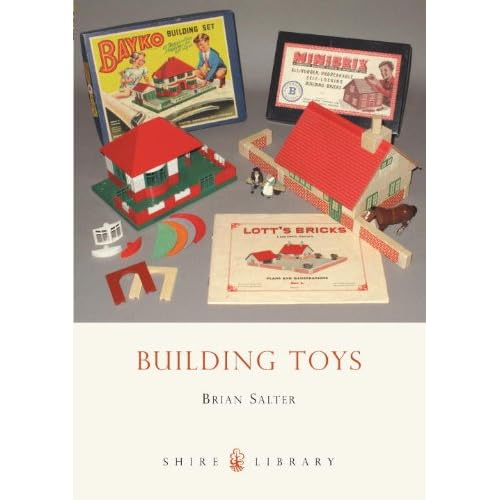
Lodomo is great fun, and there's even a fine little book called Building Toys with history & color pictures of the various kinds of Lott's sets, as well as several other types of British building sets.

Good Block Play

Tuesday, April 14, 2009

Lott's Postwar

This is a set from the Post-World War II Lott's line, but reprises the pre-war "New Series."

The pink windows strike me as yucky, and clash with the embossed brickwork and the roof. I have contemplated repainting them. The windows on the right end are transparent plastic with blue-painted framing to match the painted stones.

If I had thought through the lighting a little better I would have put a light to the right rear to reflect off those panes. I had forgotten that the windows and doors are recessed slightly back from the wall stones and then was trying to think of a good light source to illuminate those windows from within. Maybe next time.

Note that in the plan sheet above, today's structure is upper left, and the earlier post with this set is the design at upper right. I did not include booklet scans in that post.

For all that, the aesthetic shortfalls mostly cause me to hesitate, and perhaps unnecessarily choose something else to build with. Once I am started, I enjoy the building just fine.

Good block play.

Thursday, January 07, 2010

Tomola

There were Ankerstein copiers all over, some well known and others not so well known.

Tomola may fall into the least known category, or if not, the least known are ones I still haven't heard of.

The box says they are made by "The Beton and Ceramic Factory Limited Co." of the Ujpest district of Budapest, Hungary.
I am inclined to believe that "Beton" is the same as the German word, which means "concrete," and that the concrete portion of the business contributed more to the technical development than the ceramic side.

The sand may be a finer grit than we are used to in concrete, but these feel much more like concrete than do Ankerstein, much less Lott's.

Even though it's out of register, it is worth clicking on the example plan sheet to see someone else's take.

These blocks are 20mm, the same is the earliest Ankerstein, and Richter's later Kleinkaliber, rather than the 25mm of later Ankerstein or 25.4mm of Lott's. I like the size, but it is less suitable for larger structures. Same goes for me, so there.

On another note, I have been tickled with the news coming out of CES about all the 3-D stuff coming along. Now I want the new Fujifilm 3D digital camera even more.

For now, I will keep shifting my Olympus sideways for stereo pairs (below).

Much fun & good block play.