Saturday, February 18, 2006

Ball Mosaic

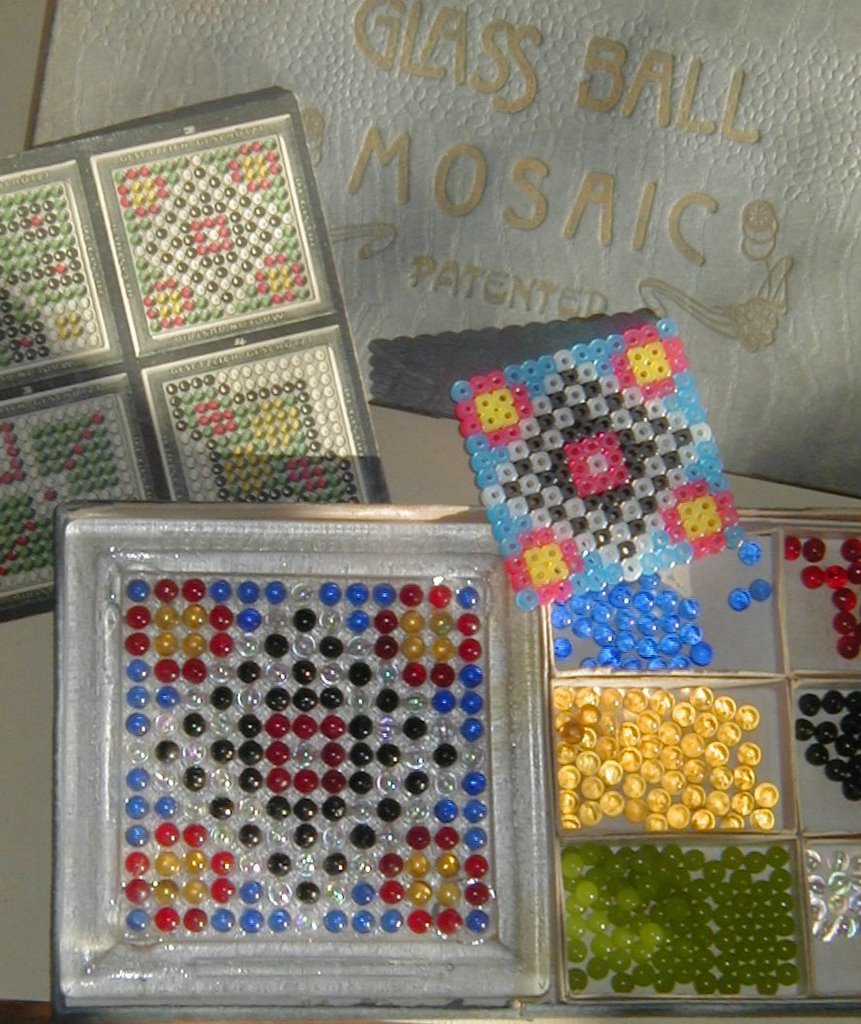
Not blocks, but not far removed from my Parquetry post of a while back. And maybe we can count that nice chunky block of glass that, with its appropriate indent pattern, forms the base of the design. Or we can claim an Ankerstein link, and reference Richter's Meteor, which came in several versions and was shown in various of the old Anchor plans booklets (scroll down to page 18).

I first learned of my glass set, illustrated above, in the Kugelmosaik web site I cited for the Richter sets. I had been using Meteor diagrams (such as those in the Vorlagenheft link for the first set -- and scroll down for an Ankerstein image!) to make fuse bead patterns with Perler and Hama beads, and was googling for more variety. That item mid-right is my newest fuse-bead block, made in counterpoint to the design I had just made in glass.

The Vorlagenheft for the glass set doesn't show blue, so I decided I would substitue blue for green at whim. Since the green is actually a poisionous greenish yellow, whim came early.The white glass balls for the set apparently went missing long ago, with some red and black beads put in the empty compartment. I resubstituted some round pearlized beads of almost the exact size. They all but disappear in the photo, but are quite gaudy in real life.

Not block play in terms of setting blocks one on the other, but certainly not far afield from blocks being arranged esthetically, with the structural elements being repetition and symmetry, rather than stack and span.

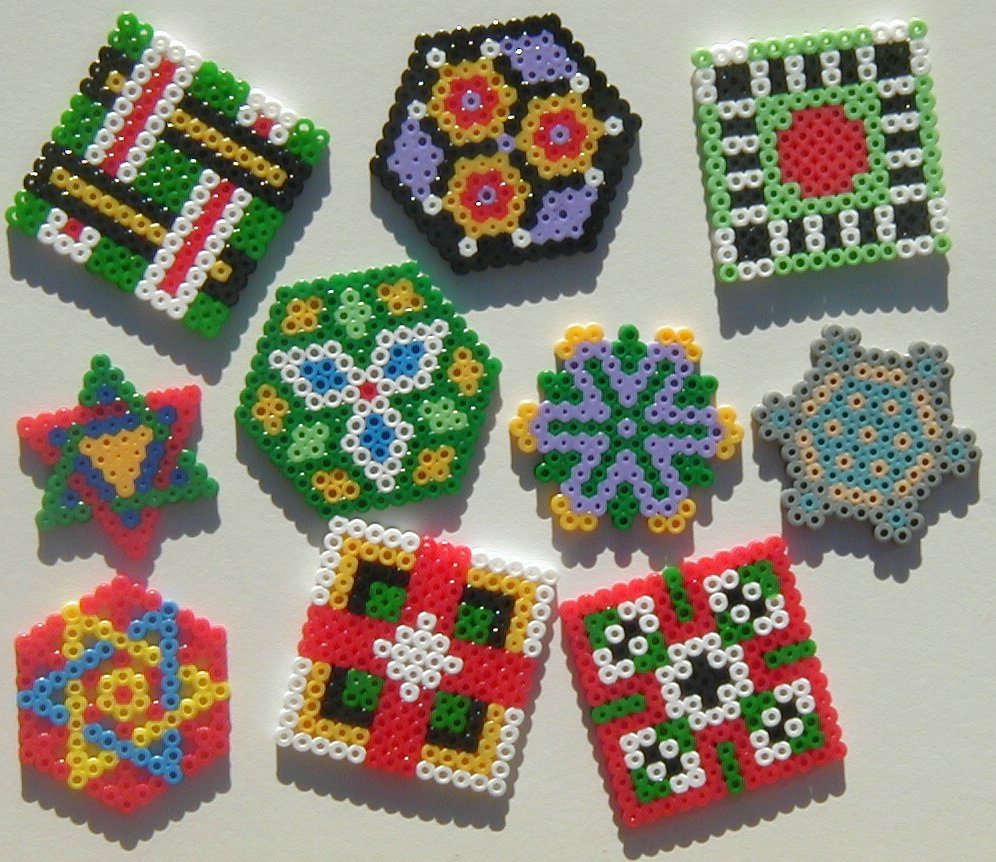
The image below shows some earlier examples of fuse-bead blocks from ball mosaic patterns. For my head at least, a similar overcoming of entropy. A satisfactory extension of block play.
Monday, January 16, 2006

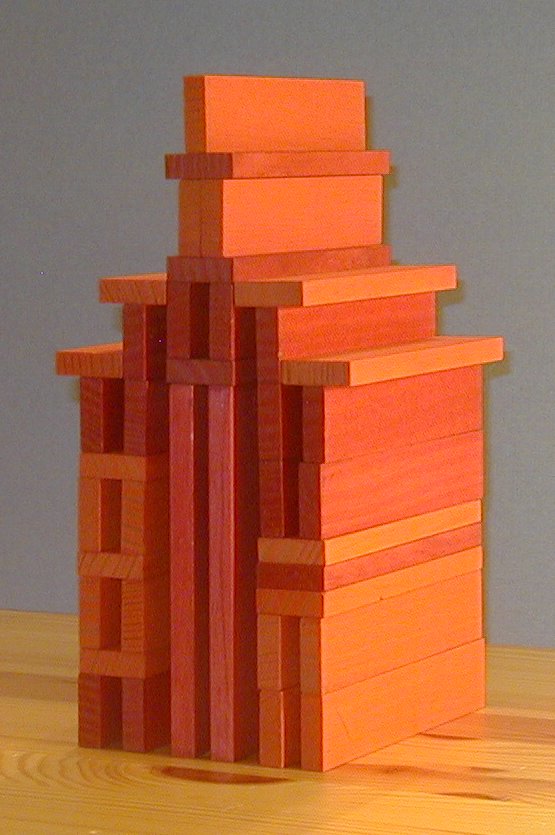
Kapla Red

One of my Chrimmus presents was from eBay, 39 red and orange Kapla sticks, and the corresponding book.

The colored Kapla sets retail for $32, and don't seem to turn up for less at all often. I had gotten the yellow/black (green?) and dark blue/medium blue sets off eBay last year, but hadn't seen a red/orange set on eBay or in local shops.

Then this stuff turned up on eBay, sans box and missing a stick. I resigned myself to being a stick short until I could color an uncolored stick to match.

But I think maybe that wore on me, and I "somehow" didn't get around to doing anything with the new set until today.

Turns out there are all forty.

The seller miscounted.

Time for some red & orange block play!

Thursday, January 05, 2006

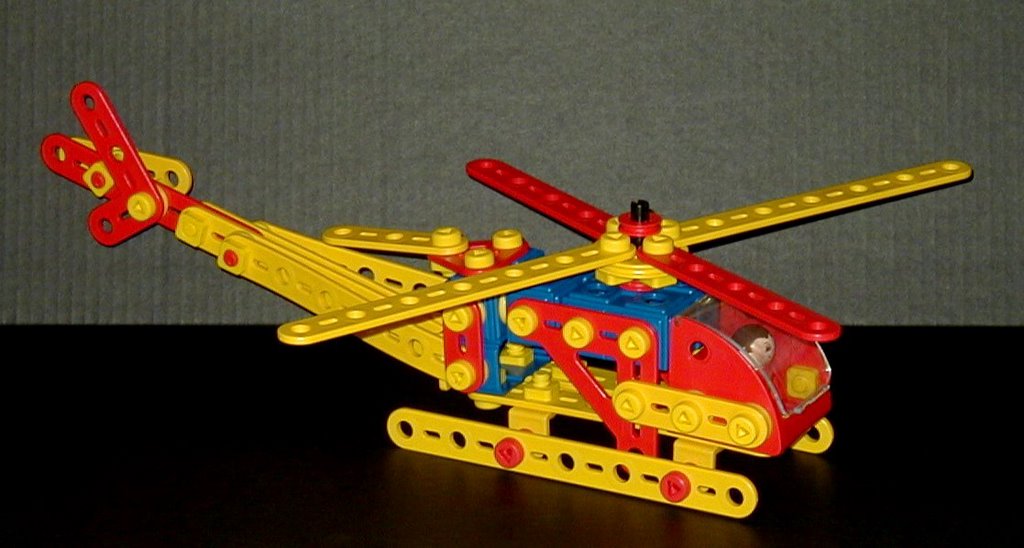
Erector Junior

This helicopter measures a little over 18 inches from the front of the cockpit to the tip of the tail, and about 17 inches from tip to tip of the rotor blades.

Unfortunately, I don't have the manual for the set, #1721, so had to build it by guess and by golly from the picture on the box and a similar picture in a catalog from the 1994 era of the set. I'd sure like to get a copy of the instruction booklet for this set. Having the box and catalog exclaim "20 models" just pours salt in the wound.

Erector Junior is Meccano Junior outside the United States, and at the time this set was made, all the Erector and Meccano products were made in Calais, France. Current sets are made in China, for Meccano, which is still in Calais, and are imported into the United States by Brio.

The body of this helicopter is made up of hollow plastic double or quad "blocks," as were constructions from most Junior sets of the era. These "blocks" seem to have been dropped from the most recent sets, taking them even further from the concept of block play.

Tuesday, January 03, 2006

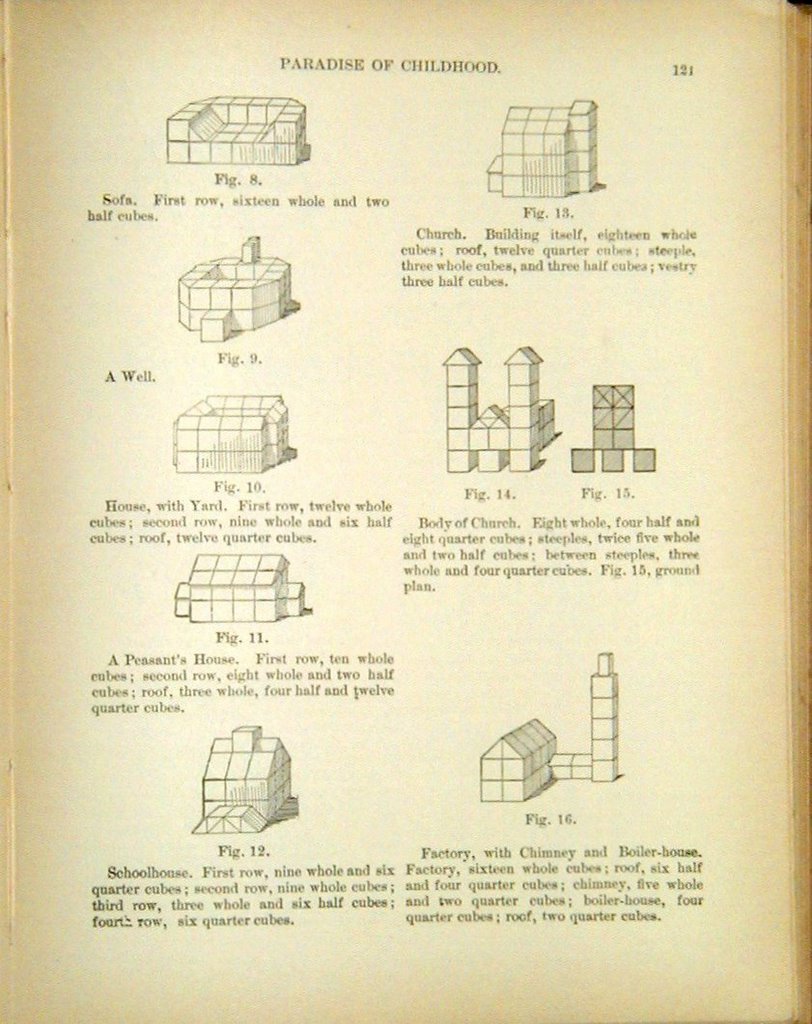
Froebel Gift Number 5

Sometimes I think that of everything that Froebel did, Gift 5 is what doomed him to being all but forgotten, his invention of the Kindergarten living in name only.

Here and there, Froebel's teachings are still studied and followed, but the vast majority of Kindergartens are not following Froebel's plan, and if you go back to how the change occurred, you will find mentions of his blocks being too small and fiddly for young children.

Whenever I get my Gift 5 set out and start playing, I find myself in agreement with the critics. Those little triangular pieces, seen here in the peaked roof over the church doors, are just a nuisance. Trying to make some of the example designs with them, particularly when they are expected to rest on each other's angled surfaces, can be enough to make me growl in frustration. This is not necessarily a good thing, particularly with what is intended for me to be a therapeutic activity.

The other block Gifts -- Gift 3, Gift 4, and Gift 6 -- are not small and fiddly, or at least not nearly so as the smaller pieces of Gift 5. (Gift 4, which I seem not to have blogged yet, although I build with it frequently, is 8 oblong pieces, having its sides in the same 1:2:4 ratio as the Unit Block. Gift 6 is an enhanced Gift 4 in the same way that Gift 5 is an enhanced Gift 3.)

Someday I'd like to have an oversized set of Gift 5, with even the smallest pieces having enough heft to be comfortable in more relaxed block play.