Showing posts sorted by relevance for query froebel unit. Sort by date Show all posts

Thursday, June 14, 2007

Unit Blocks & Froebel Gift #4


The Fourth Froebel Gift consists of eight oblong blocks which relate to the cubes of the Third Froebel Gift by being half as thick, the same width, and twice as long.

That 1:2:4 ratio is exactly that of the Unit Block which have formed the basis of Unit Block (or "Kindergarten Block") sets since 1914.

So, while I often do ift #4 exercises with the specified size blocks of 12.5 mm x 25 mm x 50 mm, I am also inclined to grab other blocks of the same proportions, and most often, those are Unit Blocks.

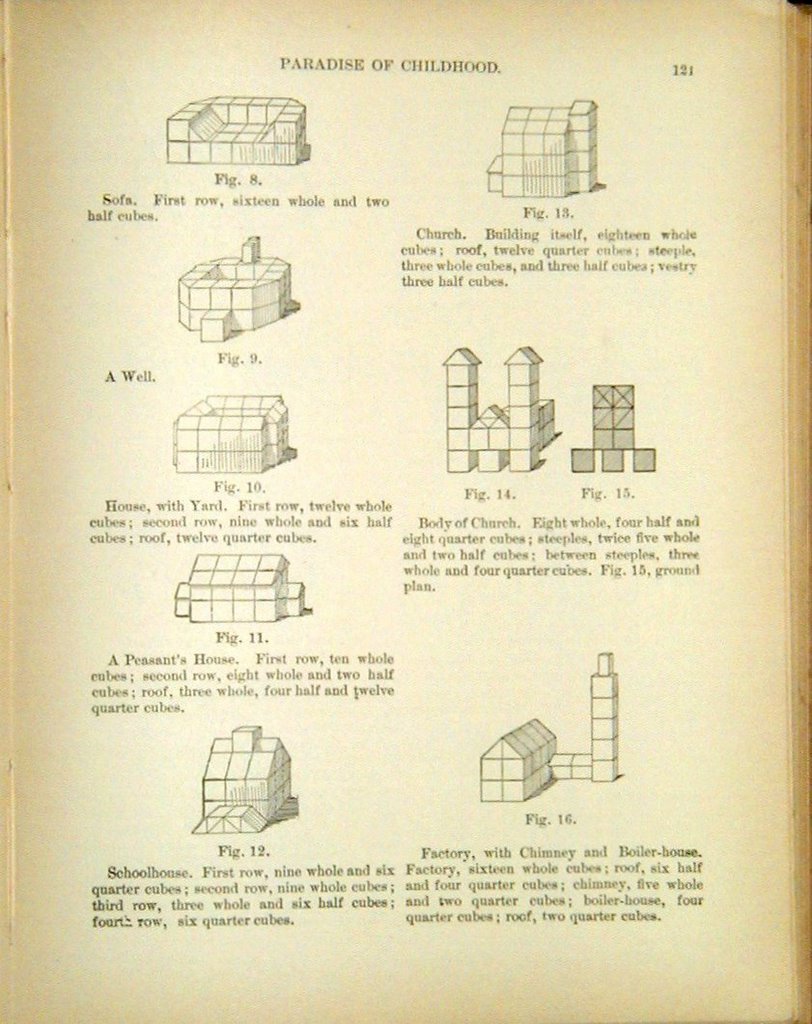
Going the other direction, if you have some Unit Blocks, and are looking for some basic designs to build, the patterns that appeared in old guides to Froebel Kindergarten activities are a very good start.

You can build them strictly by the rules, with just the 1:2:4 unit blocks, of you can use a mixture of half-units and units, as I did in the photo at top, a choice which may be forced on you by the occasional tendency of modern Unit Block sets to be somewhat sparse on actual Unit Blocks.

I have included here all of the Gift #4 "Forms of Life" included in Edward Wiebe's Paradise of Childhood, of 1869 (mine is a 1907 printing of the 1896 edition; recently reprinted in paperback), where the author acknowledges that "the plates accompanying this work are reprints from 'Goldammer's Kindergarten,' a book recently [also in 1869!] published in Germany."

The plethora of designs for the various Froebel Gifts that were widely published in a variety of books (in many languages) may have been a key part of the downfall of Froebel's style of Kindergarten: the designs were taken by uninspired teachers as being prescriptive, ignoring Froebel's intent that the designs be mere examples, and that the children should construct "forms of life" that had meaning for them, in their own lives. [See Inventing Kindergarten for more on Froebel and early Kindergartens.]

I think that in their reaction to that, the inventors of modern Kindergartens and modern Unit Blocks have tilted too far the other way, and ask us to do everything from scratch, rather than giving us some ideas and practice constructions to get us started.

With any design set, I suggest building some example designs to learn the syntax of constructing, then modifying the plans from ones own inspiration, and only then building entirely new creations. And even after exploring with full creative freedom, I believe returning to example designs, occasionally or frequently, can be an important process of the learning process.

Creative opportunities for modification or freestyle building can be enhanced by adding additional blocks, a few at a time, but I suggest starting with just enough to build the designs: 8 unit blocks, or if there is a shortage, as many unit blocks as are available, and two half-unit blocks in place of each missing unit block.

If more than eight unit blocks are available, then initial expansion of the play set might best be more basic units - in recent years, much has been made by having block sets consisting of blocks of all the same shape, such as Kapla or Dr. Drew's Discovery Blocks, and there is indeed some value in that, as Friederich Froebel discovered some time before 1836.

So click on each of the design sheets for a high resolution version, print them out, and enjoy some good block play.

Wednesday, November 11, 2009

Froebel Gift 3

How many blocks is enough? How many different block shapes are enough? How fancy do the blocks need to be?

It often seems that "more is better" is the universal response - eg Legos or Archiquest. Today we look at the other end of the spectrum, and find out that - at times at least - eight blocks, a single shape, and the simplest shape, are enough.

This is Froebel Gift 3 - part of Friedrich Fröbel's conception of early childhood education, which he called "Kindergarten" and introduced to worldwide acclaim.

The Gifts were intended to be given to children as educational toys, were very carefully designed, and were supported with well-explained lesson plans.

Following the first Gift of six soft balls in different colors and the second gift of three important shapes, Froebel's Third Gift introduced block play with eight 1" cubes of wood fitted into a cubical wooden box, to demonstrate breaking up into parts and reassembly in the same and different forms.

Unfortunately, too many of Froebel's followers were too worshipful, too unimaginative, too rigid, and missed major points of his teachings entirely, and instead followed examples in the plethora of Froebelian books as if they were gospel. Froebel's approach fell from favor, and teh Kindergarten movement sought new directions.

The banishment even extended to the blocks which make up his instructional tools in Gifts 3 through 6 (the later gifts introduced more complex educational play - including the precursor of Tinkertoys, and hence K'nex et al). They were to be replaced by Carolyn Pratt's enlarged Kindergarten Blocks or Unit Blocks, based on the rectangular blocks of Froebel Gift 4 and Gift 6.

Admittedly, the rectangular blocks do make for better play, and some of the smaller blocks of Gift 5 present real problems, but there is still something important that can be gained by a block builder spending some Block Play time with the eight cubes of Gift 3.

Click on the small scans here, from one of the last of the books of the Froebel Kindergarten era, and you can print out larger scans of kind of designs that appeared in ever-increasing numbers in book after book. If you get caught up in them to the exclusion of exploring your own designs, you may be a rigid Freobelian at heart, or you may be like me and just enjoying the therapeutic aspects.

Fortunately, Froebel Gifts are still (or again) available from different sources - even Ankerstein, whose popular stone blocks get their start as a development of Froebel Blocks, has a set in their composite artifical stone.

Many of the designs were passed forward from book to book, and were quite quaint by the end of the era- the locomotive here, and several other topics, was about as unrecognizable in 1907 as 2009 to Americans unfamiliar with early 19th century Germany.

For a bit of a digression, I have been admiring, but not quite buying, Stönees rock-shaped building "blocks," and it occurred to me that it might be fun to select eight of the more cubish (of a single color, for me), and see how many of the Froebel Gift 3 construction one could build. My previous Gift 3 post showed that I am not too rigid in what I use, at least.

I expect Stönees to deliver - just as Froebel Gifts long have - Good Block Play.

Wednesday, August 02, 2006

Campaniles &c

I got an email the other day from a university student whose research led to this blog. Preparing to respond involved some block play -- I routinely do activities from my "cope list" to try to get the brain functioning in some sort of order, and since the question I needed to answer was about the benefits of Froebel blocks, it seemed appropriate to use Froebel blocks in my preparation.

In this instance, Froebel's "Fourth Gift," which consists of eight rectangular blocks of ratio 1x2x4. But instead of the real thing, I went for an oversized counterpart in unit blocks. Some exercise with the blocks, and off I went to write and email my response. I realized when creating the link above that I have posted all of Froebel's block gifts except #4, which is probably my favorite. I shall need to correct that ommission soon.

Later I went back to the blocks and began fooling around, quickly grabbing more blocks out of the box, but sticking primarily to the basic 1x2x4 unit blocks.

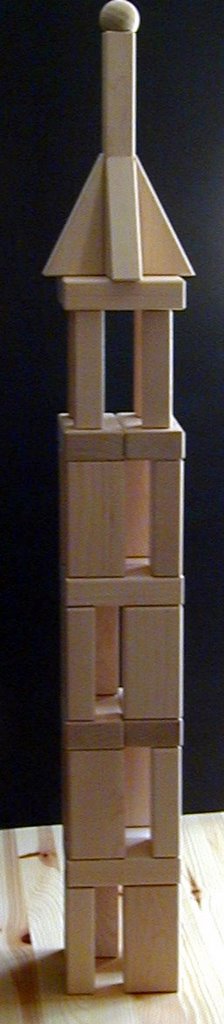
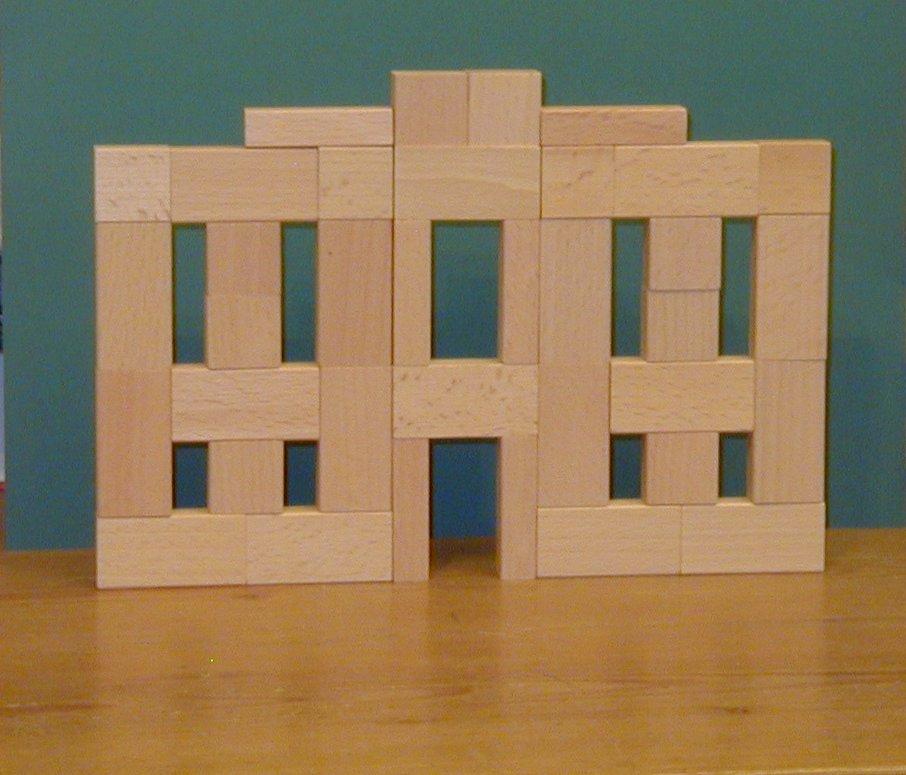
Still feeling happy about the campanile in the previous post, I began experimenting with variations, until I was happy with what I had built. I photographed it, then tore it down and began building what I imagined to be the facade of a modern office block, though when I saw the pictures, I was more inclined to consider it perhaps an old department store?

The campanile was less pleasing in the pictures, so I went back and rebuilt it with some modifications, and it is the rebuilt version that appears at left. The first try is at right, I find I dislike it less on further reflection.

The first campanile used 26 "unit" unit blocks, nine "other," and one wood ball with a flattened side; the facade 48 "units" and six "other;" the second campanile 36 "units, ten "other, and the ball again. Sort of an intermediate exercise between the "all one size and shape" of Kapla and their ilk, and the "many sizes and shapes" of most block sets.

Good Block Play.

Monday, November 16, 2009

Tinkertoys & Froebel's Peas

There is an evocative feel to Tinkertoys, for adults who played with them as children. A tactile memory. A pleasure.

These may not be the colors of the Tinkertoys I best remember from my childhood, but they are the size and they have the feel.

At my grandmothers house, between the two upstairs bedrooms, there was a space that was more than hallway or landing, and less than a full room. It had a south-facing window, a chair, a small table, just enough space for a child or two to play on the floor, and a set of Tinkertoys. I played there a lot, retreating from the noise and hubub of the living room and kitchen, faintly audible voices drifting up the stairs. Tinkertoys.

Tinkertoys were invented in 1913. The story of how the inventor got the idea from watching his children play with spools and pencils on the floor has been widely repeated since Tinkertoys achieved their first success. Personally, I wonder how one makes the leap from a pencil in a spool hole to the eight holes around the circumference of the spool. That would be the more interesting story.

But again and again in reading about inventors explanations of their great breakthrough, one is stricken by how uninformed the poor inventor must have been to not be aware of prior art, yet somehow through sheer luck and fortitude invent something just sufficiently different from prior art to be patentable, and to not infringe on existing patents, if any.

Okay. They make good stories.

We don't really know that Charles Pajeau was aware of Froebel's Kindergarten, and in particular Gift 19 (the later supply-oriented "gifts" are now often called an "occupations" in contrast the earlier equipment-oriented gifts). But the Froebel Kindergarten movement was still very active in America, with a lot of activity in the Chicago area, and I suspect I recall, Pajeau's hometown of Evanston.

But whether by direct influence, subconscious suggestion, or simply prior development, we must consider Gift 19, "Peas Work," to be the precursor of Tinkertoys. As these images support, again taken from Wiebe's Paradise of Childhood, 1869, 1896, 1907.

Froebel's Peas appeared in a world prior to canned or frozen vegetables, or year-round availability of fresh, so when they spoke of "peas" they would generally be understood to be referring to dried peas. These, when softened in water, could have wires or sharpened thin sticks poked into them, and two- or three-dimensional structures created.

Tinkertoys are a better idea, and it is not surprising that "Peas Work" has been all but forgotten, and no longer plays a role in our kindergartens.

Tinkertoys would go on to be a major player for several decades, until eventually bumped down a notch by K'nex, but even yet surviving in a sturdier, larger version. There are also imitators, smaller, larger, and in-between.

Long time Block Play readers may find today's bridge familiar - it is similar to a K'nex bridge I did a while back, but less complex. Which is a major part of its appeal.

I am particularly pleased with the unit blocks as bridge piers & abutments. Unit blocks are so useful, and I find they complement Tinkertoys a particularly pleasing manner. I suppose with standard-sized unit blocks, the new larger size of Tinkertoys would be in similar proportion as my smaller blocks and smaller Tinkertoys.

Good Block Play.

Friday, July 13, 2007

Unit blocks & Froebel Gift #6

Among the Froebel Gifts, the blocks in the Sixth Gift show the most promise for being fun to play with. But this hasn't seemed to necessarily translate well into print. I think the biggest problem is the Froebel rule that all blocks in the gift be used in each construction. I do much better in free play when I allow some to lay on the table, and better still when I have a few extra to supplement here & there.

The secret here is probably to build something from a design sheet, but when it is finished - or even before - break loose and build freestyle, using the starting design simply as inspiration.

The design in the photo is from Bauen nach Fröbel - Vorlagen und Anweisung, by Friederich Seidel, Vienna, 1890. I downloaded the source image at right in January, 2005, from - I believe - a Japanese site which doesn't seem to be there any longer, so I can't request permission to share more of the 10 pages of diagrams for Gift #6 (source corrections or updates welcome). Though they tend to be repetitive and with many artist errors, they are still interesting and potentially useful.

The image at left is from Royal Gifts for the Kindergarten, by Frances Post van Norstrand, Chicago, 1888. You may recognize design number 7 from an earlier post here, though it in fact was done from a different book - the Royal Gifts designs are a subset of those in the Wiebe book cited in my recent Gift 4 post, albeit with new art.

Compare the Gift 4 designs in the Royal Gifts scan at lower right to those in Wiebe to see the similarities. I include this scan not just to illustrate my point, but so that those wanting a compact and simple set of inspirations can print out the two single-page Royal Gifts sheets (click on the images for a higher resolution version for printing), perhaps laminated back to back for durability and convenience.

For building to the Gift 6 designs, as well as Gift 4 and a good deal of freestyle fun, I suggest IQ Preschool's "Buncha Blocks." The sets come with nice canvas carrying bags, and I divide my two sets so that all the Gift 6 style blocks go in one bag, all the other blocks (arches, dowels, planks, triangles, semicircles) go in the other - they come out almost exactly even in bulk. While this means 16 of each of the three shapes are in the Gift 6 bag, instead of the 18 + 12 + 6 of the formal Gift 6, only the strictest Froebelian formalists will suffer much. Since two of one or the other of the alternate shapes can always be made to substitute for the "oblong block" (Froebelian terminology) or "unit block" (unit block terminology), there is no constraint on building by being two short in this shape.

Whatever the blocks, whatever their size, Froebel's Sixth Gift is a fine entry point to Good Block Play.

Thursday, August 25, 2005

Froebel Gift 6

I did Froebel's Kindergarten Gift 3, consisting of 8 cubes, a while ago, and had intended to do the Froebel block set Kindergarten Gifts in order, but here I am sneaking ahead to number 6.

This set is the most fun, and seems likely to have been the inspiration for Unit Blocks, which enlarged these linearly by almost three times and added additional shapes. The three block shapes here remained the core of early Unit Block sets, per evidence in after Harriet Johnson's 1933 work; reprinted, abridged, in The Block Book

If I had a little more gumption and skill, I'd like to make a full set of unit blocks this size (about 1"x2"x1/2" for the larger rectangular pieces). They are nice to play with on the coffee table.

Tuesday, July 17, 2007

More unit blocks & Froebel 6

I guess today is cat day in Blockplay land. Though in both this and my earlier fischertechnik post, the constructions are supposed to be the primary subjects, I know there are some who will enjoy seeing Archie more than my projects - and will be demanding equal time for Webster!

The two larger models both use the full Froebel #6 sets, though there maybe substitutions, it has been a few days since I built them.

The smaller structure at lower left was built from a subset of the Froebel 6.

Having lots of different blocks to build with can be fun, and can be liberating. But it can also be intimidating. For younger children, and for those of us with developmental disabilities, whether they are full time limitations or intermittent periods of recovery from recurring autistic regression, it can be helpful to select at a subset with a limited number of blocks, of an even more limited number of types.

A very good sequence is the Froebel 4, followed by the Froebel 6, followed - in due time - by a little more variety.

All my best toys offer multiple levels of play: an easy level for regression periods, or for reentry after a period of neglect long enough to forget some of how to play with them, a medium level for regular use, and advanced level - partly for occasional bursts of enthusiasm, but mostly so I don't feel constrained at the intermediate level: I know I am there by choice.

I consider that one of the key secrets of Good Block Play.

Tuesday, January 03, 2006

Froebel Gift Number 5

Sometimes I think that of everything that Froebel did, Gift 5 is what doomed him to being all but forgotten, his invention of the Kindergarten living in name only.

Here and there, Froebel's teachings are still studied and followed, but the vast majority of Kindergartens are not following Froebel's plan, and if you go back to how the change occurred, you will find mentions of his blocks being too small and fiddly for young children.

Whenever I get my Gift 5 set out and start playing, I find myself in agreement with the critics. Those little triangular pieces, seen here in the peaked roof over the church doors, are just a nuisance. Trying to make some of the example designs with them, particularly when they are expected to rest on each other's angled surfaces, can be enough to make me growl in frustration. This is not necessarily a good thing, particularly with what is intended for me to be a therapeutic activity.

The other block Gifts -- Gift 3, Gift 4, and Gift 6 -- are not small and fiddly, or at least not nearly so as the smaller pieces of Gift 5. (Gift 4, which I seem not to have blogged yet, although I build with it frequently, is 8 oblong pieces, having its sides in the same 1:2:4 ratio as the Unit Block. Gift 6 is an enhanced Gift 4 in the same way that Gift 5 is an enhanced Gift 3.)

Someday I'd like to have an oversized set of Gift 5, with even the smallest pieces having enough heft to be comfortable in more relaxed block play.

Thursday, November 12, 2009

Stump Wedgits

Wedgits in the Woods.

My Mini Wedgits 10 piece pocket subset works really well for this. I wouldn't have had anything larger or less robust with me.

Good Block Play.

Addendum: Yesterday, I mentioned Stönees rock-shaped building "blocks," and after I posted today, I realized that they might be another Block Play option to provide I useful & fun subset small enough & robust enough to carry in a pocket.

In the past I have also occasionally carried wood or plastic cubes (blank dice) in my pocket as a robust Froebel Gift 3, and have long intended to make a small set of "mini unit blocks" to be a Froebel Gift 4 for the same purpose. [17:55 11/12/09]

Saturday, August 27, 2005

Diversion & Digression

Creativity

I feel rather proud of today's construction. It is largely of my own design. The doorway and two lowest blocks on either side being based on an example in Exploring Learning : Young Children and Blockplay
I rather enjoyed the creative process.

I began by thinking that pattern of blocks could be repeated rather attractively, adding the tall think pillars for dramatic effect. Then I worked out how to use the balance of the larger blocks (again using the 36 blocks of Froebel's #6) for roofing.

I like it.

Wedgits

Earlier I spent some time with the Wedgits. I had been backing off for a bit because the bright colors are a bit too much for me to allow extensive use. Sensory issues are a large problem for most, if not all, folks on the Autistic Spectrum, though they certainly aren't exclusive to us.

In addition to bright colors, noise can be a problem, and the Wedgits are appallingly noisy if the structure collapses.

Today I was able to wear my new noise-canceling headphones while playing, and they helped immensely. My psychiatrist had encouraged me to get them so that I would be more willing to tackle power tool projects, among other things, and I think he was very right.

Creativity

I am now wondering if I will be more willing to explore risky structures with my larger Unit Blocks if failure won't be so distressing. It has been quite routine for me to pack up and put away whatever I have been playing with if there was a noisy crash.