Showing posts with label stretch. Show all posts

Friday, March 10, 2006

Large bead design

My beadplay has continued, with intermittant meditatations on how my version of beadplay relates to what my best blockplay is for me.

I've mostly been doing small bead blocks based on quilt blocks, crochet blocks, beadwork, needlepoint, etc.

But the other day I ran across an interesting book:
American Indian Designs for Needlepoint Rugs. Other books have similar designs, but in this one, they are very close to actual size for Perler beads or Hama beads.

That means you can just place Perler's large trasparent boards over the color designs, and work directly, just like the Chicken Socks Melty Beads book, the Hama Maxi sets, or some Perler sets.

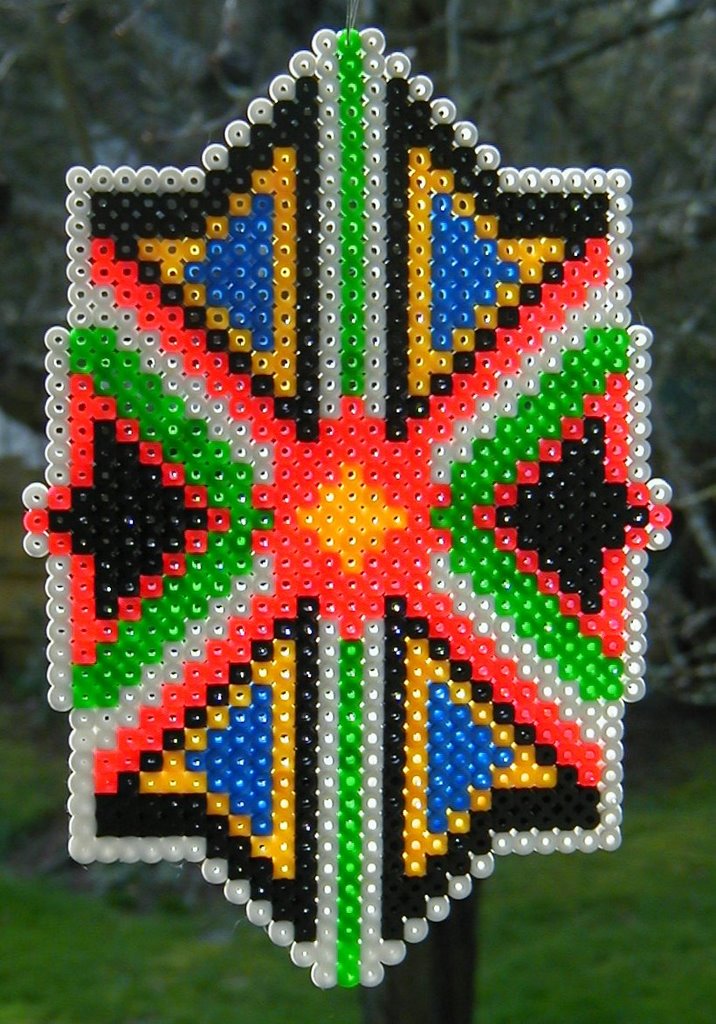
My first project from the book, on two linked Perler boards, is in the photo. (I wanted to use up some Ikea beads, which also meant I had to do some color substitution.)

Pretty nifty fun, and for me at least, a form of block play.

Saturday, February 18, 2006

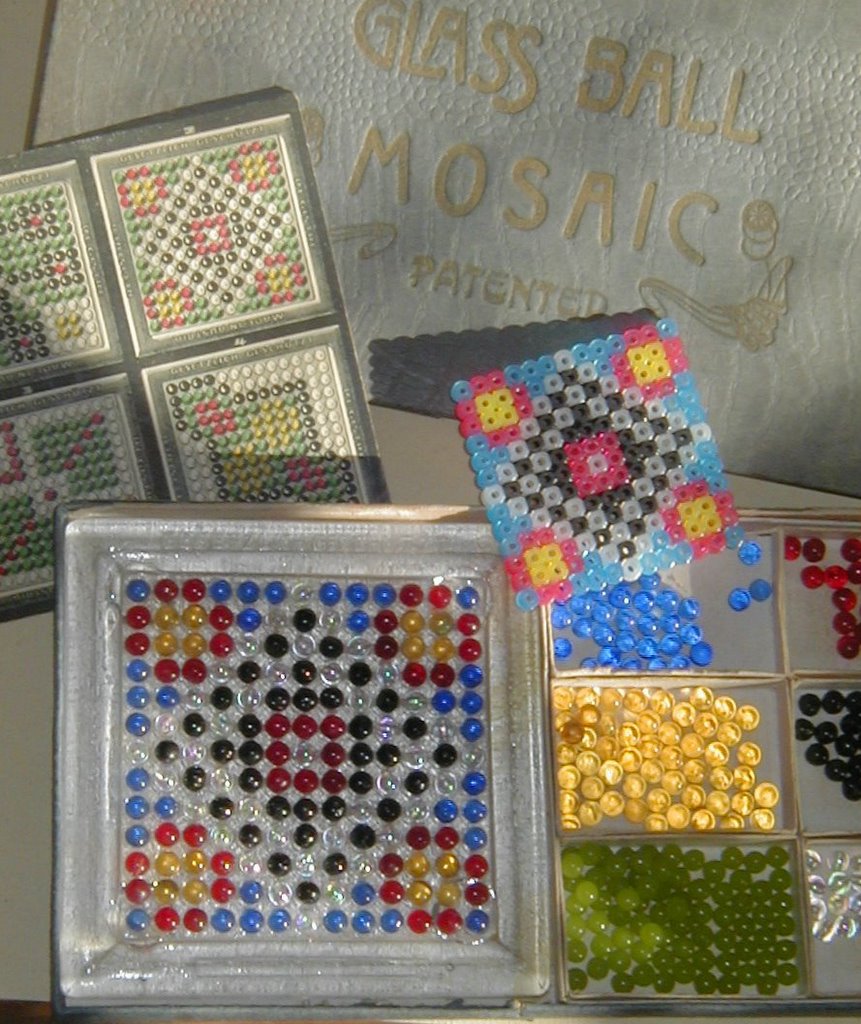
Ball Mosaic

Not blocks, but not far removed from my Parquetry post of a while back. And maybe we can count that nice chunky block of glass that, with its appropriate indent pattern, forms the base of the design. Or we can claim an Ankerstein link, and reference Richter's Meteor, which came in several versions and was shown in various of the old Anchor plans booklets (scroll down to page 18).

I first learned of my glass set, illustrated above, in the Kugelmosaik web site I cited for the Richter sets. I had been using Meteor diagrams (such as those in the Vorlagenheft link for the first set -- and scroll down for an Ankerstein image!) to make fuse bead patterns with Perler and Hama beads, and was googling for more variety. That item mid-right is my newest fuse-bead block, made in counterpoint to the design I had just made in glass.

The Vorlagenheft for the glass set doesn't show blue, so I decided I would substitue blue for green at whim. Since the green is actually a poisionous greenish yellow, whim came early.The white glass balls for the set apparently went missing long ago, with some red and black beads put in the empty compartment. I resubstituted some round pearlized beads of almost the exact size. They all but disappear in the photo, but are quite gaudy in real life.

Not block play in terms of setting blocks one on the other, but certainly not far afield from blocks being arranged esthetically, with the structural elements being repetition and symmetry, rather than stack and span.

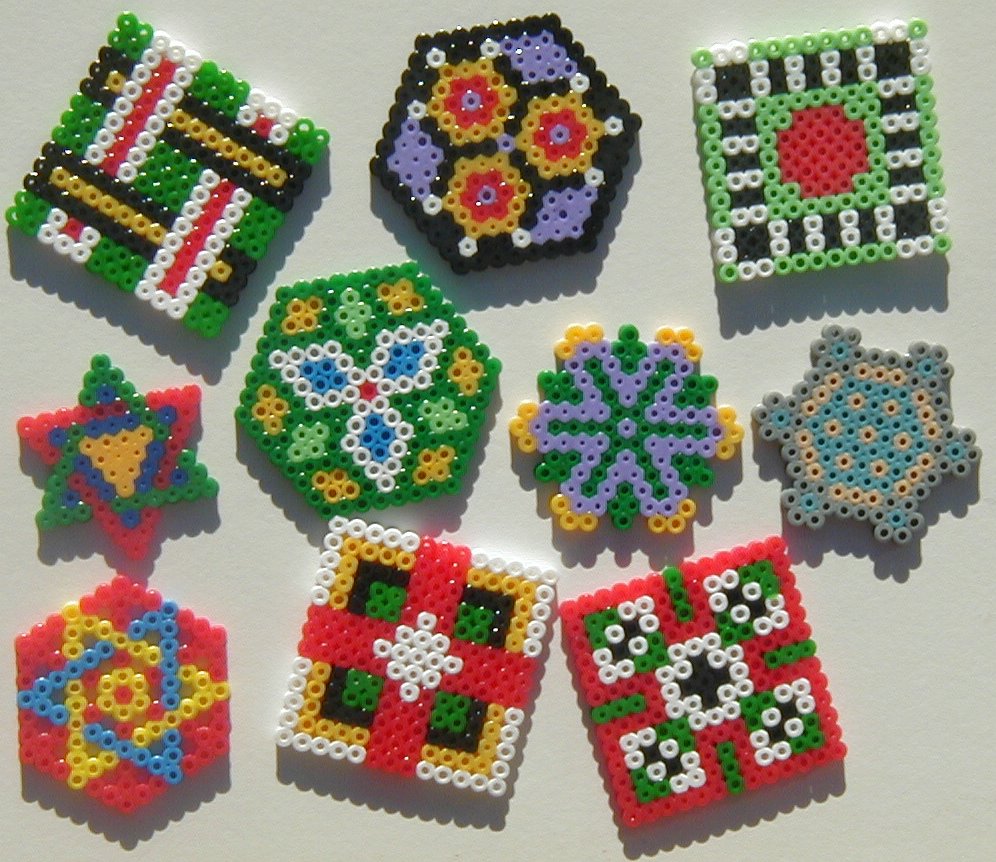
The image below shows some earlier examples of fuse-bead blocks from ball mosaic patterns. For my head at least, a similar overcoming of entropy. A satisfactory extension of block play.

Friday, November 11, 2005

Parquetry Blocks


This is a very old toy category, and although perhaps no longer as well known, Parquetry sets are still made and sold.

I played with sets like the Playskool at left when I was in Kindergarten, over fifty years ago, and their descendents are now made by Learning Resources, with the same (thick) block sizes and same sample patterns (on better paper :).

Sets like the large Czech version at upper right are more commonly called Parquetry Tiles because the polished wooden pieces are quite thin. They have a wonderful feel. Similar sets can be found in Seattle stores today, from Haba in Germany.

The sets are great fun for exploring patterns of color and symmetry, with almost universally satisfactory tactile feedback.

Wednesday, June 29, 2005

Color Cubes


I had thought I would limit this blog to architectural construction blocks, such as the Richter's Ankerstein, Unit Blocks, ArchiBlocks, and related construction toys such as Lincoln Logs, Roy Toys, etc.

But I couldn't resist temptation, and today I show another type of "block play," which also provides therapeutic benefits in dealing with mental disability.

Color Cubes are obviously closely related to building blocks, being wooden cubes in the size range of some alphabet blocks. These are about 1 3/32" (27.5mm) across, a common size for color cubes and a size in which alphabet blocks can be found.

The blocks in a set are all the same, with four solid colored sides: red, white, blue, and yellow; and two sides diagonally divided into red+white and yellow+blue. Sometimes green is substituted for the blue. These sets are used to create a wide variety of patterns, either creating simple pictures or more commonly, creating intriguing symmetrical designs.

Commercial sets of color cubes seem to have invariably been made in "square number" sets of 16, 25, 36, 49, 64, and 81. They typically came packaged with sample patterns. The only current commercial offering I know of are Magicubes from Creative Ladder, whose web site even lets you play with an online version [defunct link, sorry, but see: Uncle Goose].

Mine are a mishmash of older, battered incomplete sets, of which I have been lucky enough cubes the same size to be able to do even the larger patterns. Unfortunately I have to struggle to decipher tiny, blurry patterns from images snitched from online auction listings, since I haven't yet managed to get a set with patterns included.

If anyone reading this has sample patterns, and could email me copies, I would be very grateful.